


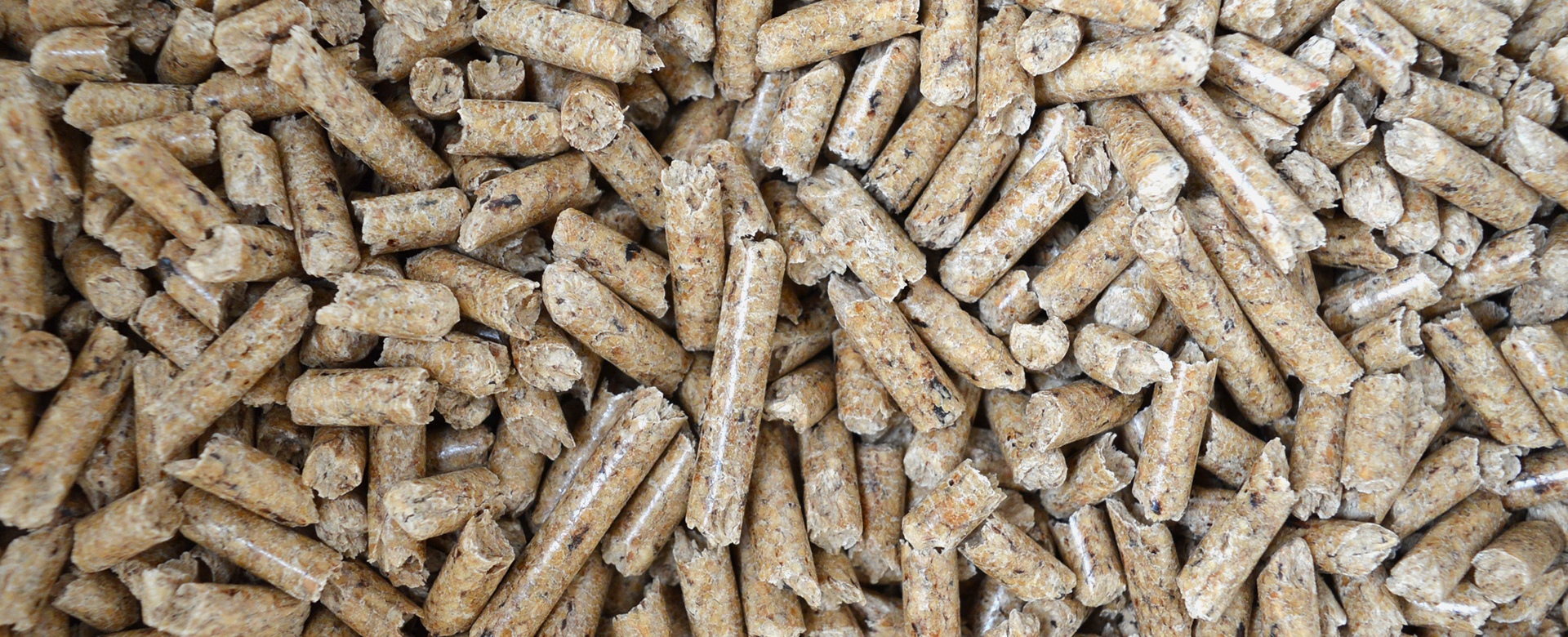
Wood is the oldest source of energy in the history of mankind and is still available today as a sawing by-product as a result of its high industrial use. Disasters such as beetle infestation or windthrow pose major challenges for the wood industry and require the creation of new energy sources in order to avoid dead loss. But raw material competition also puts other renewable raw materials in the focus of thermal use. We therefore constantly conduct research into new raw materials and processes for efficient biomass processing. In the biomass pilot plant, we develop new products and optimise output, quality, and pelleting.


We offer
Where wood is chopped, splinters must fall
We focus our research efforts on all forms of biogenic solid fuels such as wood chips, shredder wood, pellets and briquettes and the renewable raw materials for their production. We thus help the biomass industry to cope with current challenges from standardization and legislation, as well as with technology leaps and the differentiation of the product range, also beyond the energetic use, all the way to the functional and material use of resources.
Biomass research in all sizes and time scales
- Molecular level: e.g. odour and emission engineering of pellets, chemometric sensor systems and process modeling, controlling ash melting behaviour through additives
- Product level: e.g. meeting quality criteria for new raw materials, raw material screening
- Laboratory scale: e.g. small-scale experiments from Single Pellet to biological or technical raw material modification
- Biomass pilot plant scale: for all tests that would not be possible in practice or would be difficult in running plants
- Process level: e.g. instruction and implementation of tests on raw materials, mix, performance, and optimisation according to statistical test plans
- Global dimension: e.g. development of logistics solutions through mobile pelleting
- Virtual level: e.g. modeling processes, designing processes and technologies, sensor-based process control, Big Data, statistical process control, and Industry 4.0
New raw materials
We are continuously researching new wood-based and fiber-based renewable raw materials. Cultivation yields early product ranges that allow for initial potential analyses even during the growing phase and support adapted process design. Secondary raw materials such as wood and straw from deconstruction, as well as technical recyclates, can be used in a variety of ways. However, regardless of the intended use, a certain proportion typically remains unused. Here we are working to ensure that all legal and regulatory requirements for fuels can be met on this basis.
Contact Persons
Head of biomass pilot plant

Biomass laboratory

Biomass pilot plant

Our services
Raw material screening
We evaluate the raw material potential of wood types, quality classes, energy crops, agricultural residues, residues of other industrial production, or additives such as starch, thereby creating a valid basis for decision making.
Upgrading fuel quality
We constantly conduct research into processes, e.g. to keep water, ash, and nutrient content low in fuels, to avoid unfavourable ash melting behaviour, and to make products stable in storage.
Process modeling
At our biomass pilot plant, we model industrial production. This helps to save raw materials, make processes more efficient, develop new products, and optimise existing products.
Plant tests
Tests on the industrial plant must be carried out with great care. We will guide you in this delicate mission based on statistical test plans and we will determine optimal process conditions.
Technology development
We develop sub-processes and entire process concepts and offer alternatives to the state of the art. We optimize die geometries through rapid prototyping using 3D printing, laboratory and technical centre tests.
Sensor systems
Using new methods for online measurement and offline quality control, we are able to produce consistently high fuel quality and to react to process fluctuations in real time.




Available infrastructure:
- Biomass pilot plant
- Thermogravimetry: Leco, simultaneous determination of ash content for up to 18 samples
- Calorimeter: IKA, Calorific value determination and bomb digestion for elemental analysis
- Abrasion tester: In-house development, mechanical strength of pellets
- Vibratory screening machine: Retsch AS 300, Sieve tower 305 mm diameter, all common sieve sizes, fine fraction determination, sieve analysis, fractionation
- IC/UV/CD: Thermo Fisher Scientific, ion chromatography with UV and conductivity detector, sulfur and chlorine content
- Single-pellet press: In-house construction in combination with Zwick Roell Universalprüfmaschine 100 or 250 kN, heated die, various inserts for compaction and material flow studies
- Length Measurement Device: BEA, automatic determination of pellets length as well as the distribution of pellets lengths
