In accordance with the principles of the circular economy, we consider raw materials, products, and processes throughout their entire product life cycle. In this sense, residual materials or even contaminated residues are considered secondary raw materials. Services and products are designed so that it is clear what happens to them at the end of their use. Overall, this saves resources and energy. The CO2 storage capacity of wood is effectively utilized by keeping the material in circulation for as long as possible.


We offer
Close the circle …
Holzforschung Austria supports the wood industry in its development towards a circular economy sector, pursuing a holistic concept. Holzforschung Austria's circular model is based on the so-called layer model, which describes a building and the product life of the individual layers (skin, structure, services, space plan, and stuff). However, we go further and focus on use and identification, considering all aspects of environmental impact, including questions such as how materials, function and requirements change over time.
- Product life span: The longest possible CO2 sink effect is achieved when products have a long service life, require little maintenance and high-quality reuse is planned in advance.
- 10 R principles: The end of product use is referred to as EoL (end of life). At this point, residual materials should not be considered waste but should be put to high-quality secondary use. This must be planned during the development stage.
- Ecological impact: Circular economy is usually more ecological because the primary effort to create something has already been made in the first product ife cycle. However, only a detailed analysis can show exactly what impact is achieved and whether it pays off for selected product ranges.
- Economic efficiency: The economic advantages of a circular economy often take the form of easier fulfilment of tender criteria, savings in disposal costs, more efficient logistics, greater flexibility or better financing.
Download circular economy research reports
Forschungsendbericht: TimberLoop AP 2 Teilbericht - Nationale und Europäische Forschungsprojekte in Zusammenhang mit Kreislaufführung von Massivholz (pdf, 2 MB)
- author(s)
- publishing year
- 2025
- pages
- 54
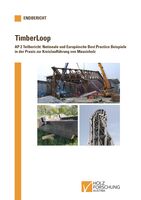
Forschungsendbericht: TimberLoop AP2 Teilbericht - Nationale und Europäische Best Practice Beispiele in der Praxis zur Kreislaufführung von Massivholz (pdf, 5 MB)
- author(s)
- publishing year
- 2025
- pages
- 57
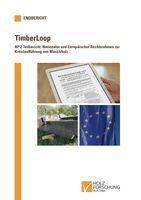
Forschungsendbericht: TimberLoop AP2 Teilbericht - Nationaler und Europäischer Rechtsrahmen zur Kreislaufführung von Massivholz (pdf, 1 MB)
- author(s)
- publishing year
- 2025
- pages
- 25
Forschungsendbericht: TimberLoop AP 3 - Materialeigenschaften alter tragender Holzbauteile im Hinblick auf ihr Kreislaufpotenzial (pdf, 5 MB)
- author(s)
- publishing year
- 2025
- pages
- 68

Forschungsendbericht: TimberLoop AP3 - Kreislaufkonzepte für tragende Holzbauteile (pdf, 2 MB)
- author(s)
- publishing year
- 2025
- pages
- 35

Forschungsendbericht: TimberLoop AP4 - Kleinvolumige Holzbauprodukte aus Altholz (pdf, 3 MB)
- author(s)
- publishing year
- 2025
- pages
- 47

Forschungsendbericht: TimberLoop AP3&4 - Kontaminationen und Schadstoffverteilung in gealterten Holzbauteilen (pdf, 6 MB)
- author(s)
- publishing year
- 2025
- pages
- 156

Forschungsendbericht: TimberLoop AP5 - Holzschutzmittelfreie Kreislaufführung (pdf, 5 MB)
- author(s)
- publishing year
- 2025
- pages
- 70
Forschungsendbericht: TimberLoop AP6 Kreislaufpotential (pdf, 3 MB)
- author(s)
- publishing year
- 2025
- pages
- 52
0 brochures in basket
Contact Persons
Circularity concepts

Chemical analysis

Life cycle analysis

Our services
Deconstruction audit
While conventional demolition does not place any emphasis on preserving the structure of wood, this is precisely the focus of deconstruction. Built-in wooden structures are assessed in terms of their circular potential and economic value in the course of the deconstruction audit, and clear recommendations for action are made.
Environmental impact
When reusing resources, the question arises as to whether specific emissions or leaching are to be expected from the previous life cycle and whether appropriate precautions need to be taken to prevent this. We carry out corresponding analyses on a laboratory scale, under model or real conditions.
Investigation of pollutants
Conventional pollutant and contaminant investigation hardly covers the environmentally relevant properties of wood-based building products and is not designed for the structure-preserving dismantling of wood. Our methods for representative sampling and our focus on precisely those analytes that are relevant in terms of previous use and circularity potential create the basis for the optimal handling of existing structures.
Life cycle analysis
Comparative life cycle analyses in particular reveal which measures achieve how much leverage and reveal relevant fields of action.